
****Set-and-Forget Protocol
**
Here's an uncomfortable truth about trading: your brain is not on your side, which is exactly why the Set-and-Forget Protocol exists.
It's not that you lack discipline. It's not that you haven't studied enough. It's that the organ making your decisions evolved for a completely different job — surviving on the African savannah, not managing risk in front of a forex chart. And when real money is on the line, that ancient brain doesn't consult your trading plan. It hijacks the controls.
The solution isn't to try harder. You've tried harder. Everyone has tried harder. The solution is to build systems that work even when your biology is working against you. The simplest, most powerful system ever devised for this is called the Set-and-Forget Protocol — and it's the single biggest behavioral shift you can make as a trader.
Here's how it works, why it works, and why it will feel deeply uncomfortable at first (that discomfort is the point).
The Problem: Your Brain Can't Be Trusted During a Trade

Before we talk about the fix, we have to be honest about the problem.
When you enter a trade, two versions of you are involved. There's the version who analyzed the setup, calculated the risk, set the stop and target, and wrote the plan. That version is calm, rational, and operating with a fully functional prefrontal cortex. That version makes good decisions.
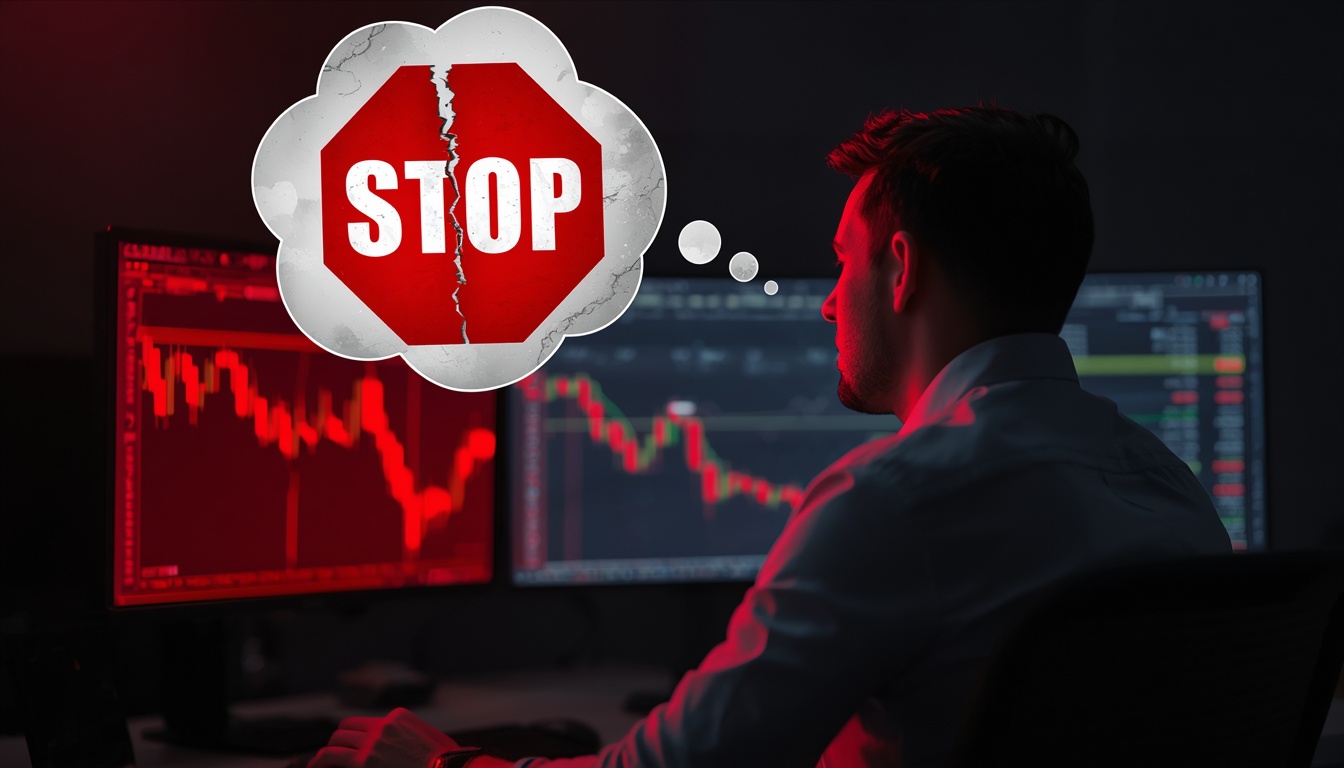
Then there's the version who holds the mouse while the trade is live. That version is watching every tick, feeling every pip, and experiencing a constant cascade of physiological reactions — cortisol on the way down, dopamine on the way up. That version is not calm. That version is not rational. And when price starts moving against the position, that version's prefrontal cortex partially goes offline while the amygdala — the ancient threat-detection system — takes over.
The result is predictable. The calm version sets a stop at -25 pips for good reasons. The live version, watching price hit -23 with cortisol spiking, starts negotiating. Support is right there. The RSI is oversold. I'll give it a little more room. The calm version sets a target at +60. The live version, watching price hit +30, starts panicking. What if it reverses? I should take it now while it's green.
Neither of these negotiations is a strategy decision. They're biology. They're the ancient brain doing what it evolved to do — avoid pain, secure gains, survive the next five minutes.
"Every time you let the live version override the calm version, you're trading against your own edge."
The Insight: You Can't Control the Live Version. You Can Remove Its Power.
Here's the key realization that changes everything: you will never win an argument with your amygdala in real time. You can't. The amygdala fires in milliseconds, faster than conscious thought. By the time you're aware of the urge to widen the stop or close the winner early, the urge has already won. Willpower is not a viable strategy against a system that operates below the level of conscious awareness.
So stop trying to win the argument. Remove the argument entirely.
That's what Set-and-Forget does. Every decision that matters — entry, stop, target, position size — is made before the trade goes live, when you're calm and rational. Once the trade is in the platform, there are no decisions left to make. The stop is set. The target is set. The size is fixed. The live version of you has nothing to negotiate, because there's nothing left to decide.
The trade runs. The stop holds or it doesn't. The target hits or it doesn't. The platform handles the execution. You handle nothing — because handling it is exactly what ruins you.
The Set-and-Forget Protocol: What It Actually Looks Like
Set-and-Forget isn't a vague philosophy. It's a specific, repeatable procedure. Here's the full protocol:
Before Entry: Do All the Thinking
This is where 100% of your decision-making happens. Before you click the button, you define everything:
The setup. Why are you taking this trade? What's the thesis? What pattern, level, or condition triggered the entry? Write it down. If you can't articulate the thesis in one sentence, you don't have a trade — you have an impulse.
The entry. Exactly where you're entering and why. Not "around here." Not "when it feels right." A specific price, based on a specific reason.
The stop. Exactly where the trade is invalid. This is the level that, if reached, means your thesis was wrong. It's not where you'll "feel like getting out." It's where the trade is objectively broken.
The target. Exactly where you're taking profit. This should be based on structure — a prior high, a measured move, a key level — not on how much profit feels "good enough."
The size. Exactly how much you're risking, calculated from your stop distance and your fixed risk per trade. This is math, not mood. Risk per trade is a constant. Stop distance determines position size. Nothing else.
All of this happens before the trade is live. All of it is written down. All of it is entered into the platform.
At Entry: Place Everything, Then Stop Deciding
You enter the trade. You place the stop. You place the target. You've already sized correctly. The trade is now fully configured.
At this moment, your job is done. Not "almost done." Not "done until you need to manage the position." Done. There is nothing left to do.
During the Trade: Do Nothing
This is the hard part, and it's harder than it sounds. During the trade, you do nothing. You don't check the chart every 90 seconds. You don't "see how it's going." You don't move the stop. You don't close early. You don't add to the position. You do nothing.
If monitoring the trade triggers anxiety — and for most traders, it does — close the platform. Walk away. The trade doesn't need an audience. In fact, the trade is significantly better off without one, because every time you look at the chart, you're feeding the live version of you more data to react to. Starve it.
At Resolution: Record and Move On
The stop hits, or the target hits. Either way, the trade is over. Record the result. Note whether you followed the protocol. Move on to the next setup.
That's it. That's the entire system. It's not complicated. It's not sophisticated. It's just complete — every decision made up front, every outcome handled automatically, nothing left to the version of you that can't be trusted.
Why It Feels Wrong at First
If Set-and-Forget sounds simple but somehow impossible to actually do, you're not alone. It feels wrong for a reason: it removes your sense of control, and your brain hates losing control.
When you're actively managing a trade — checking it, adjusting it, closing early, widening stops — you feel engaged. You feel like you're doing something. You feel like a trader. The constant micro-decisions create an illusion of mastery. You're in the cockpit, hands on the controls, making it happen.
Set-and-Forget takes all of that away. You set the trade and then... nothing. No engagement. No control. No feeling of mastery. Just waiting. And waiting feels passive. Waiting feels like you're not really trading. Waiting feels wrong.
But here's the thing: the engagement you're giving up is the exact engagement that's costing you money. Every time you "manage" a trade, you're injecting your stressed, cortisol-flooded, amygdala-driven decision-making into a process that was already complete. You're not adding value. You're adding noise. And noise is expensive.
"It's a sign that you're doing something right — and that your brain is fighting it, because your brain is addicted to the illusion of control."
The discomfort you feel when you set a trade and walk away isn't a sign that you're doing something wrong. It's a sign that you're doing something right — and that your brain is fighting it, because your brain is addicted to the illusion of control.
What the Data Says

If you're skeptical, you should be. "Just set it and forget it" sounds like a slogan, not a strategy. But the data on trade interference is remarkably consistent.
Every study of retail trading behavior finds the same pattern: traders who actively manage their positions — checking them frequently, adjusting stops and targets, making discretionary exits — perform worse than traders who set their parameters and let the trade play out. The interference doesn't add value. It subtracts it.
The mechanism is ego depletion. Every micro-decision you make during a trade — should I check the chart? should I move the stop? is that a reversal candle? — drains your finite reservoir of self-control. By the time a real decision needs to be made, you're running on empty.
"The trader who checks their position 40 times a day isn't being diligent. They're depleting themselves."
Set-and-Forget preserves your cognitive resources. All the decision-making happens once, up front, when you're fresh. After that, the trade runs itself. Your brain gets a break. And when the next setup appears, you're still sharp enough to evaluate it properly.
The Exceptions: When You Should Interfere
Nothing in trading is absolute, and Set-and-Forget has legitimate exceptions. But here's the key: the exceptions should be defined in advance, in your plan, not improvised in the moment.
Pre-defined rules for intervention. Maybe your plan says you move the stop to break-even after 1R of profit. Maybe it says you trail the stop behind structure after a certain point. Maybe it says you exit early if a scheduled news event invalidates the thesis. These are all legitimate — but they're rules, written down before the trade, not decisions made under pressure.
The difference is timing. A rule written in your plan was created by the calm version of you. A decision made while the trade is live was created by the stressed version. One is strategy. The other is biology. The protocol doesn't eliminate intervention entirely. It eliminates unplanned intervention — the kind that happens when price is 3 pips from your stop and your amygdala starts negotiating.
If you want to manage your trades, manage them with rules. Write the rules down. Follow them mechanically. That's still Set-and-Forget — because the decisions are still being made up front, even if the execution happens later.
How to Start
Switching to Set-and-Forget is a behavioral change, and behavioral changes are hard. Here's how to make it stick:
Start with one pair, one session. Don't try to overhaul your entire trading at once. Pick one instrument, one session, and apply the protocol strictly to just that. Prove to yourself that it works — and that the discomfort fades — before expanding.
Use a trade ticket that forces completeness. Whatever platform you use, make sure your stop and target are required fields before the trade can be placed. Most platforms allow you to configure this. If yours doesn't, make it a personal rule: no stop, no target, no trade.
Write down your thesis before every entry. One sentence. "Long EUR/USD because price broke the Asian range with volume, targeting the prior day's high." If you can't write it, don't take it. The thesis note is your anchor — the thing you read when the live version of you starts negotiating.
Create physical distance. After entering a trade, physically step away from the desk. Make a coffee. Stretch. Do anything that removes you from the screen. The more distance you create, the harder it is for the live version to interfere.
Log every violation. If you close early, move a stop, or add to a position outside your written rules, log it. Not as a punishment. As data. After 20 violations, you'll see the pattern — and the pattern will show you exactly where your biology is winning.
The Real Edge
Most traders spend their careers searching for an edge in the market — a better indicator, a better entry, a better strategy. They never find it, because the edge they're looking for isn't in the market. It's in their own execution.
Set-and-Forget is that edge. It's not glamorous. It's not exciting. It doesn't make for good trading room stories. But it works — because it's the only approach that accounts for the single most important fact about trading: you are a biological organism running ancient software, and that software will sabotage you every chance it gets.
"You are a biological organism running ancient software, and that software will sabotage you every chance it gets."
The traders who survive decades don't survive because they're smarter or more disciplined than everyone else. They survive because they've built systems that don't require them to be smart or disciplined in the moment. They make their decisions when they're calm, automate the execution, and remove themselves from the equation.
That's the whole game. Set it. Forget it. Let the system work. And let the version of you that can't be trusted sit this one out.
Ready to Let the System Work?
Understanding Set-and-Forget is the first step. Actually implementing it — and sitting with the discomfort — is the real work, and you don't have to do it alone.
At Maverick Currencies, we've built a community of traders who understand that the edge isn't in the indicator — it's in the systems that protect you from your own biology. We provide the education, the frameworks, and the accountability structures that turn insight into consistent execution.
👉Visit www.maverickcurrencies.com to learn more and join us today.
Disclaimer: This content is for informational and educational purposes only. It does not constitute financial advice. Trading foreign exchange, currencies, and other financial instruments involves substantial risk of loss and is not suitable for every investor. Past performance is not indicative of future results. Always consult with a qualified financial professional before making any trading decisions.
Related Articles
Mental Stops Are a Lie You Tell Yourself
Mental stops feel safe, but they rarely hold when price gets close. Discover why hard stops protect your account and your trading edge.

Duration Disparity: Why You Sit in Losers Longer Than Winners
Duration disparity reveals why traders cut winners early and hold losers too long. Learn to measure it, fix it, and protect your edge.

The Personification Trap: Why Your Brain Treats the Market Like an Enemy
Discover the personification trap that makes traders see the market as an enemy—and learn how to break the revenge trading cycle for good.