
The Break-Even Trap: Why Zero Is the Most Dangerous Number in Forex
There is no number more dangerous in forex than zero — welcome to the break-even trap.
Not -50 pips. Not -100 pips. Not a 5% drawdown. Zero. Because zero is the number that transforms a disciplined trader into a gambler — not gradually, not subtly, but the moment the red appears on the screen and the brain decides that the only acceptable outcome is making it disappear.
"There is no number more dangerous in forex than zero."
You've been there. You're down $300 on the day. Not a catastrophe. Not a blown account. Just enough to sting. And suddenly, every decision is filtered through a single, obsessive question: Will this trade get me back to flat?
You stop looking for good setups. You start looking for any setup. Criteria collapse. Position sizing creeps up. The goal shifts from executing your edge to erasing the red. And by the time you finally close the platform — usually down significantly more than you started — you've learned nothing except that the break-even trap is real, it's powerful, and you walked straight into it.
What the Break-Even Trap Actually Is
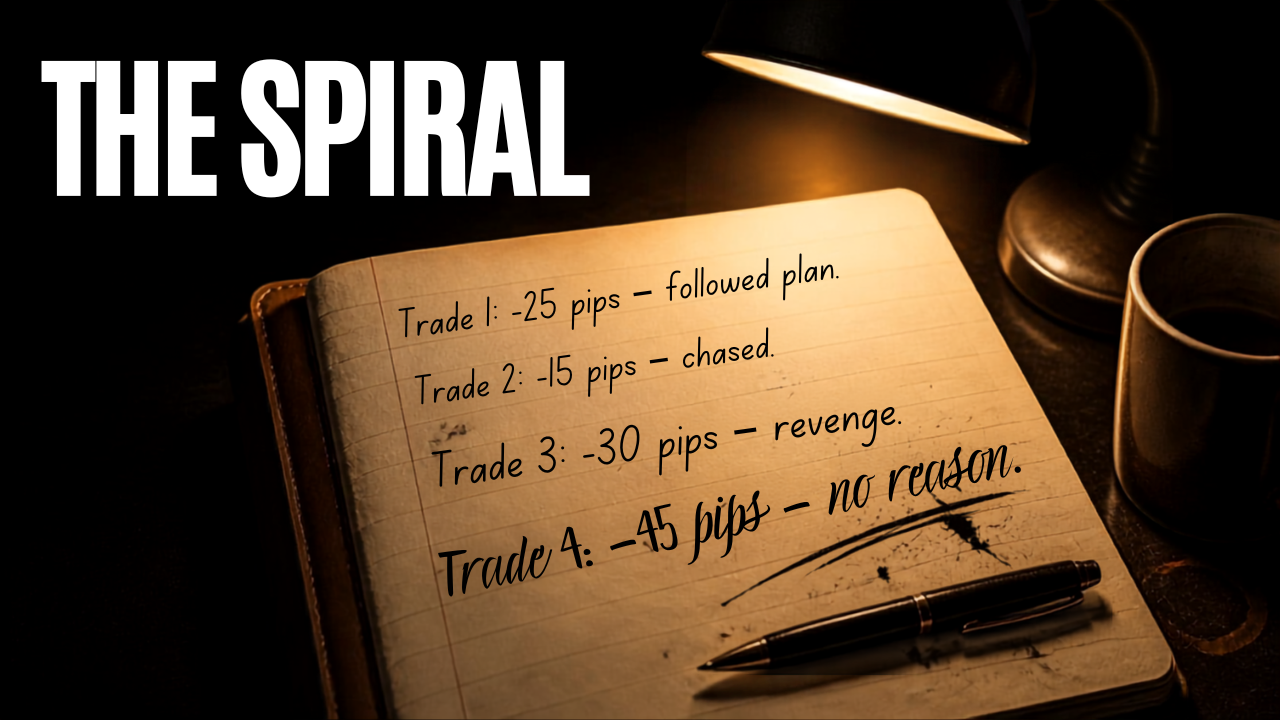
The break-even trap is what happens when a trader stops trying to make money and starts trying to recover losses. It sounds like the same thing. It isn't.
When you're trying to make money, you're asking: Is this a valid setup? Does it meet my criteria? Is the risk-reward acceptable? Does it fit my plan?
When you're trying to break even, you're asking: Could this trade get me back to flat?
Those are fundamentally different questions with fundamentally different answer sets. A trade that could get you back to flat might be a 20% probability gamble with a terrible risk-reward ratio and no technical basis whatsoever. But when the alternative is closing the platform and accepting a red day, the gamble feels like the safer option. The pain of the realized loss looms so large that the risk of an even larger loss feels smaller by comparison — even though it isn't.
This is Prospect Theory in its purest form. The pain of being down $300 is so acute that your brain will accept almost any risk to escape it. You become risk-seeking precisely when you should be most cautious. And the market — being the aggregate of every participant, algorithm, and institution — is perfectly designed to exploit exactly this moment of psychological weakness.
"You become risk-seeking precisely when you should be most cautious."
How the Break-Even Trap Unfolds
The break-even trap follows a predictable pattern. Recognizing the sequence is half the battle.
Stage 1: The Loss
It starts innocently. A trade goes against you. Maybe you took a valid setup and the market reversed. Maybe you made an error. Maybe you got slipped on news. The reason doesn't matter. What matters is that the number on your screen is red.
At this stage, you're still rational. The loss is within your risk parameters. Your plan accounts for this. One trade, one loss, move on.
Stage 2: The Reframe
This is where the trap actually springs. Your brain looks at the red number and reframes the entire session. You're no longer a trader executing a strategy. You're a person who has lost money, and your job is now to get it back.
The reframe happens fast — often in seconds. One moment you're thinking about setups and probabilities. The next moment you're thinking about break-even. The shift is almost imperceptible, which is what makes it so dangerous. You don't notice your criteria changing because you're not consciously changing them. Your brain is doing it for you, below the level of awareness.
Stage 3: The Criteria Collapse
Once break-even becomes the goal, your entry standards collapse. The question shifts from "is this a good trade?" to "could this trade work?" — and almost any trade could work if you squint hard enough.
That flag on the 2-minute chart that you'd never trade on a green day? It could work. That counter-trend reversal with no confirmation? It could work. That news spike you're chasing 30 seconds late? It could work. Your brain, desperate for relief from the pain of the loss, becomes a pattern-recognition machine that finds setups everywhere — because it's not looking for quality. It's looking for escape.
Stage 4: The Size Creep
If the first revenge trade doesn't work — and it usually doesn't — the trap deepens. Now you're down even more. The break-even target is further away. And your brain, still seeking the fastest possible relief, makes a calculation that feels logical but is actually catastrophic: If I increase my position size, I only need a smaller move to get back to flat.
This isn't trading. It's a loss-recovery algorithm running on faulty hardware. And the market doesn't care about your algorithm.
Stage 5: The Capitulation
Eventually, one of two things happens. Either you hit your daily loss limit — or a number far beyond it — and the platform forces you to stop. Or you exhaust yourself psychologically and close the laptop in disgust, down two or three times what you were down when the trap first sprung.
The next morning, you look at your trade history and can't explain half the entries. They weren't your setups. They weren't your plan. They weren't even your ideas. They were the break-even trap, and you walked through every stage.
Why Zero Is So Powerful in Trading Psychology
The power of zero isn't logical. It's emotional. And it's rooted in the same 2:1 asymmetry that drives every other trading psychology trap.
When you're down $300, your brain registers that as a loss — and losses hurt roughly twice as much as equivalent gains feel good. The pain is real. It's physiological. Your amygdala is firing. Cortisol is in your system. And your brain, seeking to escape the pain, looks for the fastest possible route back to neutral.
Zero is the neutral point. It's the line between pain and relief. Above zero, you're winning — dopamine, confidence, clarity. Below zero, you're losing — cortisol, anxiety, desperation. The drive to get back to zero isn't about greed. It's about escaping a state your brain interprets as threatening.
The problem is that the market doesn't care about your emotional state. Zero is an arbitrary line that exists only in your head. The market doesn't know what your P&L is. It doesn't know you're down $300. It doesn't know you need a 30-pip move to get back to flat. It's just ticking — and every tick you trade on tilt is a tick that's more likely to go against you than for you, because you're no longer trading your edge.
The Math That Makes the Break-Even Trap Worse
The break-even trap isn't just psychologically destructive. It's mathematically self-defeating.
Say you're down 2% on the day. A normal, manageable loss. Your plan says stop trading, review what happened, come back tomorrow fresh.
Instead, you take another trade. A marginal setup. 1% risk. It loses. Now you're down 3%.
Now you need to make 3.09% to get back to break-even — not 3%. The math of losses is asymmetrical: the percentage gain required to recover a loss is always larger than the loss itself. A 2% loss requires a 2.04% gain to recover. A 5% loss requires a 5.26% gain. A 10% loss requires an 11.11% gain. A 50% loss requires a 100% gain.
Every additional trade you take while trapped in the break-even loop doesn't just risk more capital. It makes the recovery harder — because the hole gets deeper, and the percentage required to climb out grows faster than the hole itself.
The Difference Between a Plan and a Trap
Here's the line that separates professional traders from everyone else: professionals have a plan for red days. Amateurs have a hope.
A plan for red days specifies, in advance, what happens when you're down. Maybe it's a hard daily loss limit — 2%, 3%, whatever your strategy and risk tolerance dictate — after which the platform closes and you're done, no exceptions. Maybe it's a trade limit — three trades per day, win or lose, and when you hit zero you walk away. Maybe it's a time-based rule — you only trade the first three hours of the session, and if you're red at the cutoff, you're done.
Whatever the plan is, it has to be specific, it has to be written down, and it has to be non-negotiable in the moment. Because in the moment — when you're down $300 and your brain is screaming for relief — you are not capable of making rational decisions about when to stop. The plan has to make that decision for you, before the trap has a chance to spring.
A hope, by contrast, is what most traders have. I hope I'll know when to stop. I hope I won't revenge trade. I hope I'll be disciplined. Hope is not a risk management strategy. Hope is what the break-even trap feeds on.
"Hope is not a risk management strategy."
How to Break the Loop
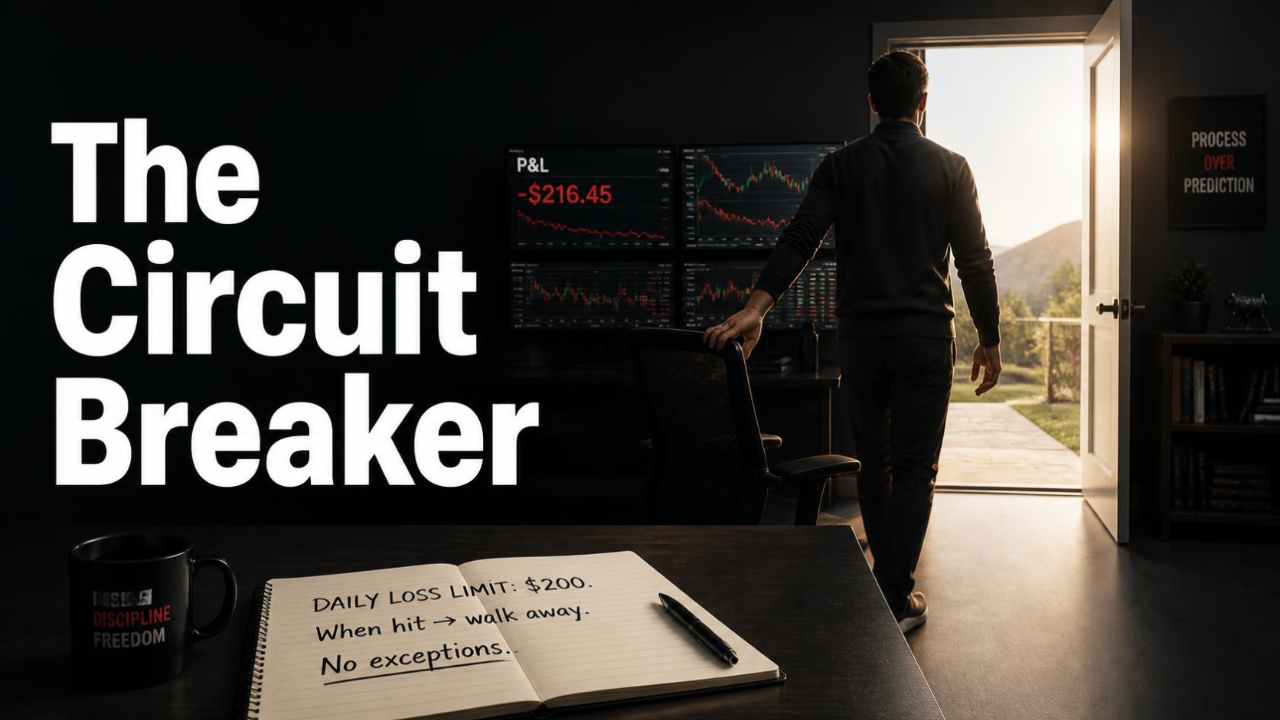
Set a Hard Daily Loss Limit
This is the single most effective intervention. Pick a number — a dollar amount or a percentage of your account — that represents the maximum you're willing to lose in a single day. When that number is hit, you're done. No negotiation. No "one more trade." The platform closes. You walk away.
The number should be small enough that hitting it doesn't cause emotional or financial damage. If losing 3% of your account would send you into a spiral, your limit should be 2%. The point isn't to maximize your trading time. The point is to survive long enough to let your edge play out.
Cap Your Trades Per Day
A daily loss limit protects your capital. A trade limit protects your psychology. Set a maximum number of trades per session — not just losses, but total trades. If your edge typically produces 2-3 quality setups per day, cap yourself at 3. When you hit zero trades remaining, you're done, regardless of your P&L.
This rule prevents the slow bleed where you take eight marginal trades and end up down without ever taking a single catastrophic loss. It also forces you to be selective — because every trade you take consumes a limited resource.
Separate Your P&L From Your Decision-Making
This is harder than it sounds, but it's the skill that underlies everything else. You have to learn to evaluate trades based on process, not outcome.
A losing trade that followed the plan is a good trade. A winning trade that violated the plan is a bad trade — and actually more dangerous than a loss, because it reinforces the behavior that will eventually blow your account.
If you can't look at your P&L without it affecting your next decision, hide it. Most platforms let you minimize or remove the P&L display. Do it. Trade the chart, not the number.
Have a Post-Loss Routine
After any loss — especially one that stings — have a mandatory routine. Step away from the desk. Make a coffee. Stare at a wall. Do ten pushups. Anything that physically removes you from the screen and interrupts the neural loop that drives revenge trading.
Fifteen minutes minimum. The urge to immediately re-enter fades faster than you think — but only if you give it space to fade.
What Professionals Know About the Break-Even Trap
The break-even trap is not a sign of weakness. It's a sign of being human. Every trader who has ever opened a platform has felt the pull of zero. The difference between those who survive and those who blow out isn't that the survivors never feel it. It's that they've built systems that prevent the feeling from becoming an action.
A daily loss limit that triggers automatically. A trade cap that forces selectivity. A P&L display that's hidden when it needs to be. A post-loss routine that breaks the revenge loop before it starts.
None of this requires iron willpower. It requires a plan that was written before the red number appeared — because the version of you that exists when you're down $300 is not the version of you that should be making decisions.
The break-even trap is real. Zero is the most dangerous number in forex. But dangerous doesn't mean unbeatable. It means you need to take it seriously enough to build systems that work even when your brain is screaming at you to get back to flat.
Ready to Break the Trap?
Understanding the break-even trap is the first step. Building the systems that keep you out of it is the real work — and you don't have to do it alone.
At Maverick Currencies, we've built a community of traders who understand that the edge isn't in the indicator — it's in the systems that protect you from your own psychology. We provide the education, the frameworks, and the accountability structures that turn insight into consistent execution.
👉Visit www.maverickcurrencies.com to learn more and join us today.
Disclaimer: This content is for informational and educational purposes only. It does not constitute financial advice. Trading foreign exchange, currencies, and other financial instruments involves substantial risk of loss and is not suitable for every investor. Past performance is not indicative of future results. Always consult with a qualified financial professional before making any trading decisions.
Related Articles

Duration Disparity: Why You Sit in Losers Longer Than Winners
Duration disparity reveals why traders cut winners early and hold losers too long. Learn to measure it, fix it, and protect your edge.

The Personification Trap: Why Your Brain Treats the Market Like an Enemy
Discover the personification trap that makes traders see the market as an enemy—and learn how to break the revenge trading cycle for good.

Revenge Trading: When Loss Becomes Personal
Discover why revenge trading destroys trading accounts, the neuroscience behind it, and proven steps to break the cycle before your next trade.